· By APEX
How to calculate macros from calories
You can calculate your macros here. It will give you protein, carbs and fat targets in grams.
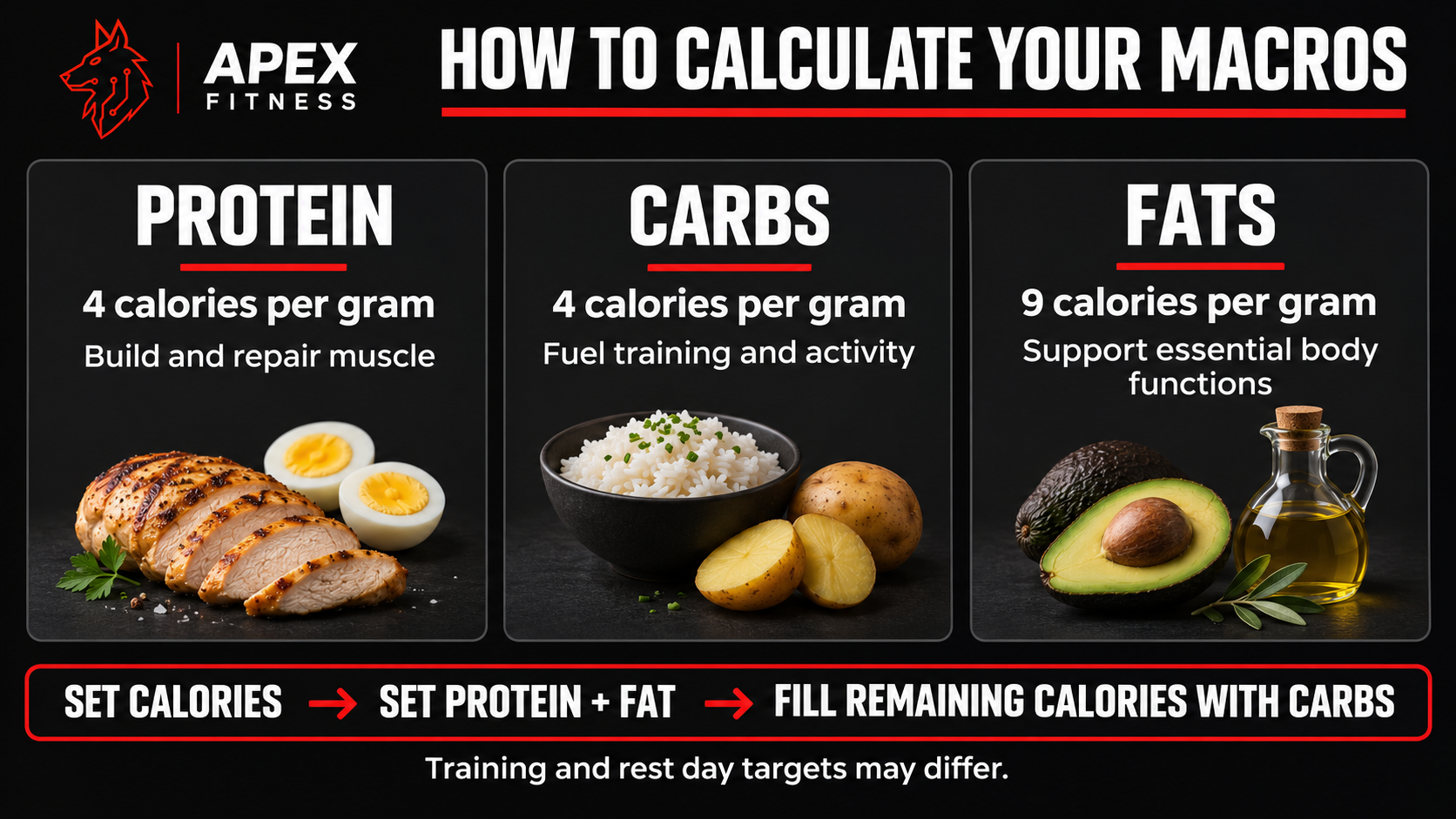
The process is simple:
-
Start by giving the calculator your daily calorie target (if you don't have it, go to the Calorie Calculator first or select the Estimate my calories option.
-
Then choose your unit system and enter your age, sex, weight, height, goal and training frequency (days per week).
-
Tap on the Training background and daily movement section, then select your lifting experience, current trainin consistency and movement outside workouts. This is used to calculate calorie and macro targets according to a more accurate expenditure. (Optional)
-
Once done, tap on Calculate my Macros and expect to get your protein, fat and carb targets back. You can use these targets to plan your daily meals.
Here's a more in-depth explanation of how this happens as well as a brief guide on how you can do it by yourself.
Start by using your actual calorie target
Let's say you’re a 30-year-old man who weighs 176 lbs or 80 kg, at around 5 ft 11 in or 180 cm tall and has intermediate training experience with 3 to 4 days of workouts every week.
For you, a 2,400-2,500 calorie target would be enough for maintenance.
If you don't know your calorie target, use the calorie calculator first. It will give you an estimate of all the calories you should eat according to your actual expenditure.
If not, get your calories amount from the calculator above.
How does the macro calculator work?
It's pretty straightforward:
-
Starts by setting a protein target according to your age, sex, weight, goal, and training days per week (about 23% of the calories you input).
-
Then calculates your fat target (about 28% of all calories). Whatever unassigned calories are turned into carbs (in this case, about 49% of your total calorie target). These values may differ depending on person.
-
The carbohydrate target will vary depending on whether it's training day or a rest day. For training days, it's usually significantly higher, where all added calories are supposed to be carbs.
-
Your protein and fat targets don't change regardless of day, they're automatically calculated based on science-based formulas. Only carbs vary.
The formulas behind all these calculations need to consider your personal details before giving any specific number. The more accurate information you give the calculator, the better the results.
A 2500-calorie worked example
You enter 2,500 calories as your target to maintain weight. Then the calculators will give you this back:
| Nutrient | Training day | Rest day |
|---|---|---|
| Protein | 145 g | 145 g |
| Fat | 78 g | 78 g |
| Carbs | 325 g | 280 g |
| Calories | 2575 kcal | 2400 kcal |
If you turn these values into calories, you'll see 2,500 calories (as the average). Check here.
Calculating macros for REST DAYS vs. TRAINING DAYS
You may think macros are the same for every single day. That would be if you aren't trying to improve your performance when it matters most, or reduce your intake when you aren't going hard at the gym.
For the example we're using, let's say they train four (4) times a week. That's 2,500 calories per day. Every week that would be 2,500 x 7 = 17,500 calories every week.
But some days you need more energy than others right? You eat more calories those days.
APEX makes it so in training days you end up eating a bit more (higher carb targets).
So instead of 2,500 x 7, with APEX it would look more like this:
2,575 x 4 = 10,300 calories (four training days)
2,400 x 3 = 7,200 calories (three training days)
10,300 + 7,200 = 17,500 calories every week
As you can see, your total and the average ends up being the same (2,500 calories per day), but you now have a higher amount of calories where it matters most (training days).
And of course, it forces you to eat a little bit less on resting days where you will likely not need as many calories and carbs.
Here's how protein is calculated
For most people who exercise, 1.4-2.0 grams per kg or 0.6-0.9 grams per lb of bodyweight is enough protein a day to support muscle growth and maintenance, which gives you a useful starting range based on your body weight.
For most people at beginner to intermediate levels around 1.6 grams per kg or 0.7 grams per pound) of protein a day will give most of the benefits to grow and repair.
APEX does not only use basic formulas, it also uses your training and nutrition goals + other details to choose a protein range which may not be the same as general guidance imply.
In the example above (80g / 172lbs man), a target of 145g protein would be the minimum range for them to hit. For high-frequency individuals, this number might be slightly higher.
How to calculate your fat target
For fat, APEX uses a percentage range based on your goal and a minimum based on your weight. For this example, 78g of fat meets the minimum of the range at about 28% of total calories. The target will likely change based on different factors (frequency, age, and height).
Each fat gram has 9 calories. That's about 702 calories for 78g of fats. When you add the 580 from protein, you’ve already used 1,282 of the 2,500-calorie target.
NOTE: If the calorie target is too low to fit everything, the calculator may lower your fat target to the minimum. Then fill up the remaining calories with carbs as expected.
Whatever calories are left turn into carbs
Once protein and fat are set, the remaining calories will be divided by four so you can get your total carbs (each gram of carbohydrates is worth 4 calories).
The formula is as follow: Carbs in grams = (calories − protein grams × 4 − fat grams × 9) ÷ 4
Example:
For a 2,500-calorie target;
(2,500 − 145 × 4 − 78 × 9) ÷ 4
This equals to 304.5g of carbs (rounds to 305g).
These will differ depending on how often you're training and the intensity level of your workout plans. Of course, age, weight, height and any additional activities you perform may also alter the result.
Don't forget to log your meals
Having your macro targets is jus the beginning.
Your job now is to start logging everything you eat so you can see how they fit into your daily targets.
If you haven't done this before, you'll notice how you may be eating more calories than you need (this is pretty common). In some cases, you may be eating enough calories but not enough protein. And for other people it's meeting their carb targets that's difficult.
Either way, you'll see how having your actual macro targets ready helps you eat better in general.
Of course, this is given you're using APEX for logging your meals. It will not only help you find out your actual macro targets, but also find accurate macros from all your meals using its own estimates from meal photos.
At the end of the day, these targets will just give you a place to start. What matters is that you stay consistent.
And more importantly, if you use APEX, your targets will consistently change as you log more of your meals, keep making progress and stay consistent with your workouts.
This calculator uses a simplified version of APEX’s initial target algorithms. The app will eventually give you better targets to follow according to your actual meal and workout history.
Macro calculator FAQ
How do I calculate my macros?
The easiest way is to find out your calorie target first. Then use a range for protein between 25-35% and a range for fats between 25-30%. The rest of those calories, usually between 35-50%, will become your carbs.
What are the macros for 2,500 calories?
For most lifters, an average example would be 145g protein, 78g fat, and 305g carbs. This is because protein and carbs are 4 calories per gram. Fat is 9 calories per gram. In this example, 145 x 4 = 580 calories in protein. In carbs, 305 x 4 = 1220 calories. And fats, 78 x 9 = 702.
580 (protein) + 1220 (carbs) + 720 (fat) = 2,502 total calories
What is a good macro split for muscle gain?
It depends on your actual needs and goals. For most people, muscle gain is maximized by maximizing protein.
Should my macros change on rest days?
Yes, but mostly if you'd benefit from actually eating more carbs. For some people, the difference between a rest day vs training day macros may not be that different. Highly active users, however, may need significantly higher carbs on training days.
Can I use calories I already know?
Yes. Enter the number and let the macro calculator figure it out. The calculator will divide the calories intro macros by adjusting them to your actual goals.
Do I need my body-fat percentage?
No. You only need to know all the info the macro calculator asks for. All other details may be useful after you've used the app for enough time.
Why don't my macros add up exactly to calories?
The calculator will give you macro estimates, automatically rounded up to the nearest. Some of APEX calculations may not fit entirely with a typical calorie count. This is why you may notice a target mismatch of up to 10kcal in some cases. But that's entirely normal.
How is this different from the calorie calculator?
The calorie calculator will only get your calories according to all the different factors you need to input. The macro calculator can give you both the calories AND the macros. And if you input a calorie target you know about, you end up saving some time.
Sources and method
- Mifflin et al. (1990). A new predictive equation for resting energy expenditure.
- Jäger et al. (2017). International Society of Sports Nutrition Position Stand: protein and exercise.
- Morton et al. (2018). Protein supplementation and resistance training.
- NIDDK. Body Weight Planner.
Track your meals against your daily targets
Bring those targets into your day by logging meals and workouts together in APEX, so you can compare what you eat with the numbers you’re aiming for.


Keep learning
Still choosing a goal? Try the bulk, cut, or maintain quiz before setting your calories.