· By APEX
Losing Stubborn Fat: Is a 1,000-Calorie Deficit Too Aggressive?
Yes... but not always. There are legitimate uses for a 1,000-calorie deficit. Here we explore all the trade-offs: fat loss, muscle retention, training performance, and more.
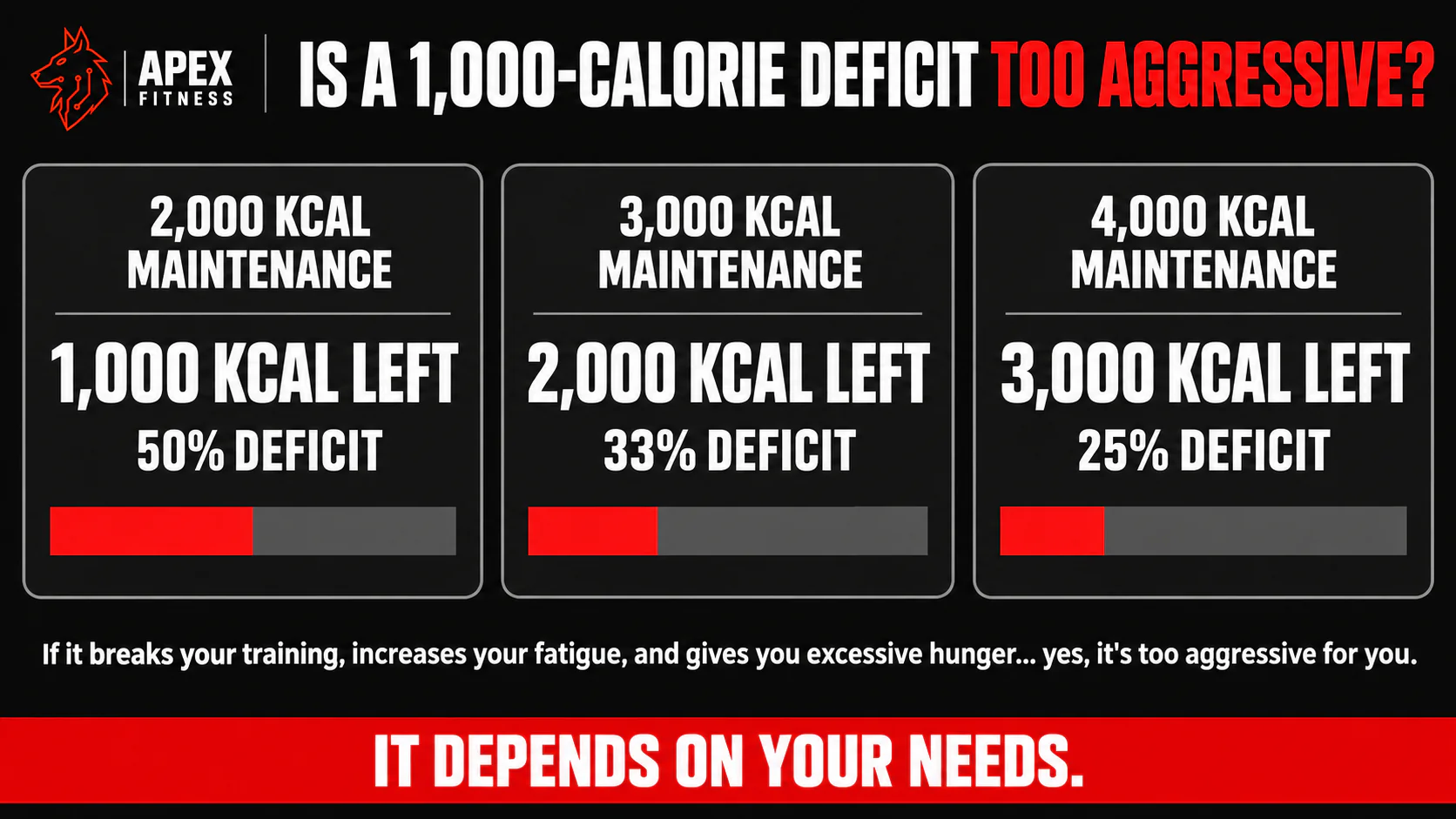
So, should you go on a 1,000-calorie deficit to lose stubborn fat?
No. But in some cases, yes.
It can be too aggressive if you're already lean and you just want to lose stubborn fat.
But it can be a worthwhile target if there's a particular short-term goal you want to achieve.
But if we were to make a general statement, it all depends on your goal, but generally it's not a good idea.
Especially if your goal is to build muscle at the same time, aggressive deficits actually make gaining lean mass a lot harder.
Now, there are many caveats to consider:
-
What are your actual maintenance calories? The number may look less scary depending on what you need.
-
What is your actual goal? Losing fat, preparing for competition, etc.
-
How long do you plan to perform the deficit for? A few days vs. several weeks changes a lot.
-
Where are you starting in terms of body fat? Leaner, more muscular people require a lot less of a deficit to make it work.
We go through all of these and a lot more below.
A 1,000-calorie deficit looks different depending on where you're starting
A calorie deficit is the gap between the amount of energy your body uses every day and the energy you actually consume through food (when it's less than what your body needs).
Say your maintenance calories are 3,500 calories and you perform a 1,000-calorie deficit. That means you're eating 2,500 calories.
Why does that matter?
Well, 1,000 calories represents a different percentage of your total intake when your maintenance is higher or lower.
Here's an example:
| Estimated daily maintenance | Daily deficit | Total daily intake | Reduction from maintenance |
|---|---|---|---|
| 2,000 calories | 1,000 calories | 1,000 calories | 50% |
| 3,000 calories | 1,000 calories | 2,000 calories | about 33% |
| 4,000 calories | 1,000 calories | 3,000 calories | only 25% |
This doesn't mean a person with a 4,000-calorie maintenance will be able to recover more easily or feel better on a 1,000-calorie deficit compared to a person with a 2,000-calorie maintenance.
However, it's generally safer to go on a specific calorie deficit if it's a lower percentage of your total calorie intake.
So before you go on any deficit, make sure it's actually something you can tackle. Start by learning your actual maintenance using our calorie calculator.
For most people, going beyond 30% of their maintenance calories is not a good idea.
A +40% deficit increases the risk of muscle loss, nutrient deficiency and severe fatigue.
A moderate 10-20% deficit is usually the best for most people looking for quicker results.
In this case, that would be 400 calories for a 2,000-calorie maintenance or 800 calories for someone on a 4,000-calorie maintenance diet.
TAKEAWAY: The same deficit looks very different if your maintenance is on the lower end of the spectrum than if it's higher than average. Match it accordingly.
Your goal is usually the most important part anyway
An already lean lifter looking for further definition and someone in obesity treatment need different advice.
Someone who's already lean (below 20% body fat) and trying to look leaner does not only want to lose fat. They want to keep as much of their lean mass as possible or possibly increase it.
Their priorities will be entirely different from those of a person suffering from obesity, and thus the same deficit of 1,000 calories will probably be too aggressive.
For them, a slower deficit is better than an aggressive one.
But for an obese person, what's optimal may be entirely different. Some organizations like NICE recommend 800-1,200-calorie diets as treatment for overweight people and a maximum duration of 12 weeks to avoid any potentially dangerous side effects.
On the other hand, we have the person in the middle of the road. They're lean, but they also have a very specific goal: getting to a certain weight in a very short amount of time.
An MMA fighter at 176 lb/80 kg is looking to cut down to 165 lb/75 kg in a week or a few days. A 1,000-calorie deficit would look excessive in their off-time, but now that they need to reach a certain weight for competition, it doesn't look that crazy.
Obviously, they need to retain muscle and overall performance. Alongside proper medical supervision, this person may find a 1,000-calorie deficit ideal. But only briefly.
TAKEAWAY: It varies enormously per person, so make sure your goal and your current maintenance calories fit how much of a deficit your body can handle. For most goals, except treating obesity or preparing for competition, a 1,000-calorie deficit is too aggressive.
How long do you want to perform this deficit for?
As we've already mentioned, it depends on what your goal is.
But for most people, aggressive deficits need to be within a certain period of time to prevent any unwanted health complication.
Too much of a deficit for too long and you'll start looking at things like:
- Excessive muscle loss
- Dangerous physical fatigue and energy loss
- Mental fogginess and memory loss
- Potential drowsiness and risk of fainting
The risk of this happening increases the lower your maintenance calories are and the longer you keep a 1,000-calorie deficit (or any similarly aggressive one).
There's no specific rule to follow regarding duration, but here's an estimate of what should work for most people:
| Estimated daily maintenance | Daily deficit | Deficit severity | Duration for safety | Primary risk factor if longer |
|---|---|---|---|---|
| 1,800 calories | 1,000 calories | 55% | Days | Malnutrition, severe muscle loss and gallstones. |
| 2,000 calories | 1,000 calories | 50% | Few weeks | Increased fatigue, nutrient deficiency, mild muscle loss |
| 3,000 calories | 1,000 calories | about 33% | +4 weeks | Muscle loss risk, hormonal dysregulation and increased hunger |
| 4,000 calories | 1,000 calories | only 25% | +8 weeks | Diet fatigue and performance decline |
These are estimates, though. Everyone is different and may react with wildly different results accordingly.
TAKEAWAY: The higher your maintenance calories, the longer you can perform an aggressive deficit. For most people under 2,500-calorie maintenance, however, it's a good idea to avoid doing a 1,000-calorie deficit for longer than a few days.
What is your current body-fat percentage?
Fat tissue is your body's energy reserve. People with higher body fat levels can handle bigger deficits for much longer and with way fewer side effects than someone who's already lean and muscular.
Here's how you should look at it:
| Estimated body fat (male) | Energy buffer | Possible side effects | Should you do the deficit? |
|---|---|---|---|
| 10-15% BF | Critically Low | Loss of muscle mass, hormonal suppression and severe fatigue | No, avoid aggressive deficits |
| 15-22% BF | Low/Moderate | Poor sleep, muscle loss, irritability and worse performance | Only for short periods (1-2 weeks max) |
| 22-30% BF | Moderate/High | Hunger and occasional energy dips | Probably okay for a few weeks |
| >30% BF | Very high | Minimal muscle loss or psychological effects aside from hunger | Usually encouraged on aggressive weight-loss plans |
IMPORTANT: These may look completely different for females, although the research is limited. The table values above only show male numbers.
In short, if you're already lean, an aggressive energy restriction will reduce or take away your lean mass gains because your body can't release energy quickly enough to cover the gap.
But if you're 25-30% body fat or more, then an aggressive deficit should not affect you as much, as you're less likely to break down critical lean mass.
If you want to find out how to lose fat and build muscle at the same time, check our body recomposition guide.
TAKEAWAY: The lower your body fat level, the less of a deficit you need to cut stubborn body fat. Especially if you want to keep muscle and strength, you should probably only do a 1,000-calorie deficit if you're over 25% body fat.
Can you lose stubborn fat without losing muscle?
Yes. But it's dependent on where you start, how much of a deficit you're doing, and how long.
An aggressive deficit of 1,000 calories has a ridiculously high chance of draining your muscles, especially if you do it for more than a few days and you're already lean with enough muscle.
For people with higher body fat levels and with less muscle on their bodies, it will depend. Most can actually handle a heavy deficit without losing that much muscle.
For this to happen, however, a few things need to align:
-
Resistance training is essential = the easiest way to lose muscle on a deficit is to stop training. If instead you train most days and keep improving your weights, reps and intensity over time, you may keep a lot of your muscle or possibly build more.
-
Eat tons of protein = eating more protein during a deficit is an easy way to reduce muscle loss. It doesn't fix excessively large deficits and lack of training, but it reduces muscle breakdown significantly. A safe idea: around 0.7 g per lb or 1.6 g per kg of body weight should help.
-
Track everything = both your workouts and, more importantly, your meals. Make sure you're following the right plans so you're going towards the right goal. This is not for the sake of tracking, but so you know exactly what you've been doing, and whether you need to reassess.
Once you have all these nailed down, it will be a lot easier and a lot more likely for you to start losing stubborn fat. But sure enough, it requires a lot of hard work and discipline, especially when and if you don't see results right away...
How do you know if your deficit is too much?
Whether you're doing a 1,000-calorie deficit or a milder one, there are several key signs to look for:
-
After a couple of weeks of consistent weigh-ins, is your weight going down at a moderate pace?
-
Are you able to lift with the same weights and reps as before?
-
Can you recover from intense workouts like before the deficit?
-
Can you continue with the deficit without falling into self-defeating behaviors (binge-eating, skipping the gym, etc.)?
If the answers to these questions are negative, you're probably on too much of a calorie deficit. It's usually a good idea to turn the dial down a little bit before continuing.
In contrast, if you see results at a moderate pace, hard training is still manageable and you don't feel any particular side effect (excessive fatigue or hunger) that could affect you, then keep going.
But if your weight has gone down too aggressively and your performance starts to decline, you're always tired, and/or hunger is hard to control, then review before continuing.
Will a bigger deficit get rid of stubborn belly fat?
No. A bigger deficit doesn't let you choose where fat disappears from.
If your lower belly seems like it's not moving while the rest of your body clearly is, that's still NOT a reason to double down on a bigger deficit.
Especially if you're already experiencing side effects on recovery, energy, and hunger, it's better to REASSESS and switch to a slower, stable pace.
Stubborn fat is called stubborn for a reason. You may not see results within weeks. For most people, a low-to-moderate deficit spreading over months is the best way to burn stubborn fat.
How much of a deficit should you actually do?
It depends, once again, on who you are and where you're starting.
Things that matter:
-
What's your current maintenance calorie target?
-
How much physical activity do you do every week? How many training sessions?
-
Is your goal only to lose fat, or do you want to build/maintain muscle?
Once you know these, it's a lot easier to find out. But for most people, a deficit should stay within 0-20% of their maintenance calories. Anything above that is probably too much, especially once it extends more than a few days.
If you don't want to guess, feel free to check our calorie calculator. It will tell you exactly how much of a deficit to do depending on your goals and profile.
BOTTOM LINE
The best way to lose stubborn fat is making a consistent, long-term effort to keep a low-to-moderate calorie deficit until the results start to show up.
For many people, this could take weeks. For others, it could take months. Some people may not see actual results for way longer than they expect, while others may see them right away.
The reality is that genetics play a huge role in how fast and where fat goes away first.
So should you do a 1,000-calorie deficit? Probably not.
Unless you're >30% body fat and/or have a specific goal to follow (like losing weight for a competition), you're better off doing a moderate to low deficit.
Calorie deficit FAQs
Is a 1,000-calorie deficit always unsafe?
You can't establish safety from a number. A 1,000-calorie deficit looks very different for someone who needs 3,500 calories in maintenance vs. someone who only needs 2,000 calories. That's why medical context, training demands, goals and personal details matter more. A severe restriction at this level may only be appropriate within a medically supervised obesity treatment program. Even then, that doesn't make it unsafe right away. Context matters.
What is the best rate of weight loss to preserve muscle?
A slow weight loss rate of 0.7% of body weight per week is probably safer than losing more than 1% of body weight per week. Gradual approaches, done consistently over long periods of time, tend to be more effective at losing weight and fat, while keeping muscle over time.
Does rapid weight loss cause faster regain?
No. Gradual and aggressive deficits have similar rates of success, but quicker losses tend to produce weight regain more easily. Having said that, muscle loss and other side effects may be much more important risks to take into account than weight regain.
Can I keep cutting if my strength hasn't dropped?
If your strength is going down, that's a sign you're probably cutting too quickly. But if it hasn't, that still doesn't tell you whether your deficit is too large or not. Other recovery symptoms like fatigue, excessive soreness, and increased hunger may be clearer signs, especially with loss of lean mass.


Sources
- Murphy C, Koehler K. Energy deficiency impairs resistance training gains in lean mass but not strength: A meta-analysis and meta-regression. Scandinavian Journal of Medicine & Science in Sports, 2022. https://pubmed.ncbi.nlm.nih.gov/34623696/
- Garthe I, Raastad T, Refsnes PE, Koivisto A, Sundgot-Borgen J. Effect of two different weight-loss rates on body composition and strength and power-related performance in elite athletes. International Journal of Sport Nutrition and Exercise Metabolism, 2011. https://pubmed.ncbi.nlm.nih.gov/21558571/
- NICE. Overweight and obesity management, NG246. Physical activity and diet, recommendations 1.16.8 to 1.16.12. Updated January 2026. https://www.nice.org.uk/guidance/ng246/chapter/Physical-activity-and-diet
- Mountjoy M et al. 2023 International Olympic Committee's consensus statement on Relative Energy Deficiency in Sport. British Journal of Sports Medicine, 2023. https://pubmed.ncbi.nlm.nih.gov/37752011/
- Hudson JL, Wang Y, Bergia RE III, Campbell WW. Protein Intake Greater than the RDA Differentially Influences Whole-Body Lean Mass Responses to Purposeful Catabolic and Anabolic Stressors: A Systematic Review and Meta-analysis. Advances in Nutrition, 2020. https://pubmed.ncbi.nlm.nih.gov/31794597/
- Purcell K et al. The effect of rate of weight loss on long-term weight management: a randomised controlled trial. Lancet Diabetes & Endocrinology, 2014. https://pubmed.ncbi.nlm.nih.gov/25459211/
- Ramirez-Campillo R et al. A proposed model to test the hypothesis of exercise-induced localized fat reduction, including a systematic review with meta-analysis. Human Movement, 2022. https://hummov.awf.wroc.pl/A-proposed-model-to-test-the-hypothesis-of-exercise-induced-localized-fat-reduction,143162,0,2.html
- Brobakken MF et al. Abdominal aerobic endurance exercise reveals spot reduction exists: A randomized controlled trial. Physiological Reports, 2023. https://physoc.onlinelibrary.wiley.com/doi/10.14814/phy2.15853